Archive: November 27, 2025

Beyond compliance: GSI enhances industrial safety through best-practice, ECSA-accredited compressed gas safety training

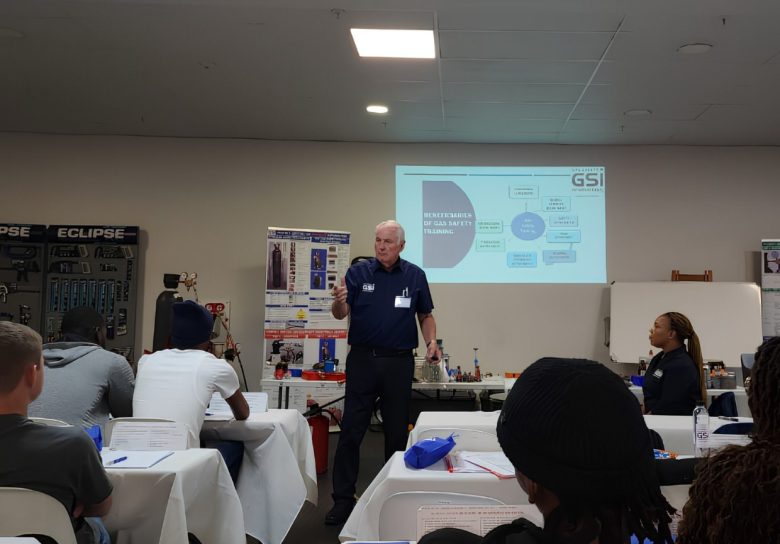
Compressed gas safety is one of the most critical issues throughout industry today. Across many sectors including mining, petrochemical, maritime and engineering, the risk of fires, explosions and equipment failures related to the use of compressed gas in activities such as welding remains ever-present. In response, GSI, a subsidiary of First Cut, has over the last forty years positioned itself at the forefront of industrial safety training, offering a comprehensive, Engineering Council of South Africa (ECSA)-accredited programme which goes beyond compliance, to deliver lasting workplace improvements.

Unique accreditation and international recognition

Compressed gas remains a cornerstone of industrial processes. However, without proper training, the risks are considerable. Peter Rohlssen, Managing Director at GSI, explains: “Gas safety training is not a box-ticking exercise. It is about protecting lives and property – as well as ensuring sustainable business operations.”

GSI’s comprehensive compressed gas safety training covers the technical and human aspects of safety. “We distinguish between Safety One – which is ensuring safe and compliant equipment – and Safety Two, which is about correct training of the operators who use it. True safety can only be achieved when both elements are fully addressed,” Rohlssen advises.

Currently, GSI is the only ECSA-approved compressed gas safety training service provider in Africa. ECSA subjects every course to rigorous review by engineers before granting approval. Every year, GSI must resubmit its material for re-evaluation, ensuring that its courses remain aligned with the latest safety standards and industry best practices.

“Our training material is carefully assessed and re-approved annually. This ensures that our courses are not only technically sound, but also up to date with evolving industry standards. Our clients know they can rely on us for world-class training, which is benchmarked against global best practice,” Rohlssen says.

GSI’s Level Three course carries five Continuous Professional Development (CPD) points, an important incentive for engineers, who must retain their professional accreditation. This recognition underlines the depth of the training and its contribution to career progression, while also demonstrating its importance in meeting legal and regulatory requirements such as those set out in the Mine Health and Safety Act.

Cost versus benefits of training

Some companies still view training as an avoidable expense. GSI is quick to point out that the cost of training is negligible compared to the financial, legal and reputational consequences of an accident. Rohlssen explains: “For example, if a training course costs one hundred thousand rand, the potential cost of a major incident at a mine can easily exceed many millions of Rands. When the consequent reputational damage and downtime are also factored in, the training return-on-investment is obvious. Training is the most effective way to reduce risk and ensure compliance while maintaining operational continuity.”

This cost-benefit perspective is reinforced by GSI’s internal training material, which emphasises how risk assessment, decision-making and risk management ensure elimination of hazards: “Without a proper understanding of compressed gas safety, companies end up tolerating high levels of risk. With the right training, however, there is a clear pathway towards effective risk assessment, structured decision-making and ultimately the elimination of hazards,” Rohlssen says.

Flexible, bespoke training

GSI offers bespoke training programmes tailored to specific vertical industries and client needs, ranging from mining to petrochemical plants, shipyards and even universities. This flexibility allows GSI to address unique hazards, procedures and operational contexts.

“We have designed and delivered customised training solutions across many industries,” Rohlssen says. “Whether it is a mine, a shipyard or a chemical plant, our focus remains the same: to empower operators and managers with the knowledge to reduce compressed gas safety risks and ensure a safe working environment.”

Rohlssen warns against the rise of unaccredited providers offering short, superficial courses which fail to address the full spectrum of compressed gas safety risks: “Mediocre training may appear to be attractive because it is shorter or cheaper – but it does not stand up to scrutiny,” he says. “GSI’s five-day compressed gas safety training programmes are comprehensive because they need to be. We cannot compromise when people’s lives are at stake.”

The company’s global track record, experience and outlook – demonstrated by its training initiatives not only in Europe but also in Malaysia, India, and both north and south America – reinforces the universality of compressed gas safety risks, and the importance of consistent standards across borders.

“Our role is not only to deliver accredited training, but also to change mindset and behaviour. We want companies to move from a culture of reactive to one of proactive safety. When compressed gas safety training is embraced, accidents decrease, productivity improves and workers go home safely at the end of the day. That is the ultimate measure of success,” Rohlssen concludes.
HDGASA and SAMCRA collaborate on steel roof sheeting to ensure safety and quality

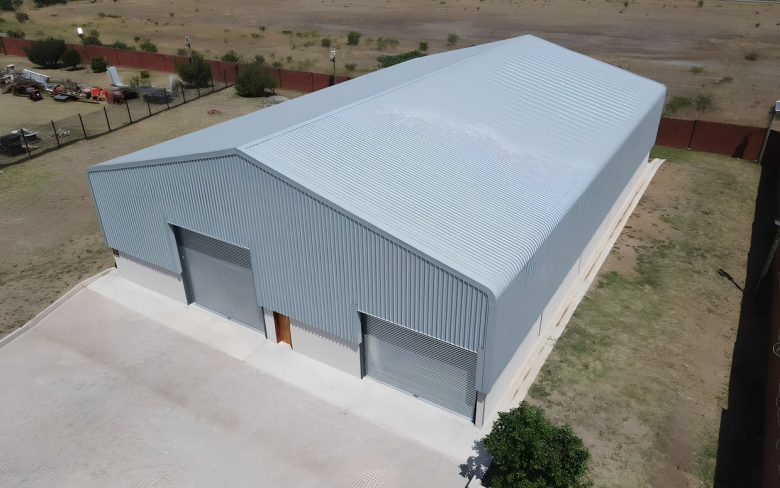
Although steel roofing has long been a primary construction material in industry, it is becoming increasingly popular in both the commercial and residential spaces. However, many end-users – and even members of the industrial value chain – are not fully aware of the different steel thicknesses, or of metallic and organic protective coatings. This increases the risk of substitution with inferior products, especially in the price-sensitive lower end of the market.

This is why Dennis White, head of the Southern African Metal Cladding and Roofing Association (SAMCRA) and the Hot Dip Galvanizing Association of South Africa (HDGASA) are lobbying for the new South African Bureau of Standards (SABS) standard – developed specifically for self-supporting metal cladding, including metal tiles – to be elevated from best-practice to mandatory status, as part of the soon-to-be revised National Building Regulations. This will make the standard a legal requirement.

Old technology, contemporary challenges

Corrugated galvanized steel roofing dates back to the Victorian era, when the sheets were hand- dipped to produce a very thick coating of approximately 79 microns. Today, the steel is pre-galvanized, with coatings ranging from 4 to around 19 microns thick, and often augmented by organic or painted coatings of varying quality and thickness.

Contemporary challenges include draining from photovoltaic (PV) panels or inert surfaces onto a galvanized surface. This produces an accelerated corrosion effect known as drip spot corrosion. Within 18 months of placing PV panels on to an existing galvanized roof, rust spots appear. SAMCRA and the South African Photovoltaic Association are now writing a joint code of practice to deal with this.

Another revolves around preventative maintenance: “If there is proper preventative maintenance, a roof will virtually last forever. However, if there is only reactive maintenance after a leak, it is too late. That can be a very costly,” White observes.

In South Africa, one of the biggest concerns is the thickness of both the steel core and coating on hot dip galvanized steel sheeting typically used for informal, sub-economic housing: “Currently, material sold into this sector by unscrupulous dealers is 0.18mm thick, with a 4 micron galvanised coating – compared with the 0.46mm thickness and 14 micron coating deemed to satisfy the National Building Regulations. People are being cheated in terms of what they are purchasing.”

Safety and quality concerns

“Now, the quality of the product has reduced to a point where it is no longer safe. There is a mandatory national standard that specifies the forces sheeting has to withstand – but this is ignored by these unscrupulous dealers,” White warns.

He explains that a rudimentary structure or shack typically consists of a couple of blue gum poles to form a skeleton. The steel sheeting is the so-called weatherproof skin on the outside. The contents of shack are often made up of synthetic fabrics – such as bedding – which burns very quickly at high temperatures. A fire burns through this very thin metal and jumps from one shack to the next. This is a crucial safety issue.

“That is why we want this new standard to be converted to a mandatory specification, which will make it illegal to sell sub-standard steel sheeting. The committee that is working with this has determined a minimum thickness for the steel core because, when it comes to metal cladding, the strength of the product – that is, its ability to span between two supports – is related to the thickness of the steel core, whereas the thickness of the coating provides the durability of the product.”

‘Steely’ collaboration

“Collaboration between organisations such as SAMCRA and the HDGASA is crucially important. Not only do we contribute to the development of these critical quality standards, but we also help the greater steel supply chain – and industry as a whole – to understand the very real problems arising from poor quality and non-compliance.

It comes down to two pools of knowledge focused on one particular area: the safety and quality. As such, we are a network of specialists and industry associations, staffed by dedicated technical experts, working in close collaboration to keep this ship afloat and on a steady course,” White concludes.

AES: Partnering with thermal energy users to recover condensate and waste heat

Strong partnerships with thermal energy users optimise opportunities to benefit from condensate return (CR), waste heat recovery and the prevention of system contamination says steam and boiler operations and maintenance service provider, Associated Energy Services (AES) Commercial Director, Dennis Williams.

Condensate return

“Steam quality is the responsibility of AES on sites it manages, and this includes protecting the boiler assets and the quality of steam supply, to ensure optimised plant and boiler operations.

Although facilitating condensate return is officially outside AES’s remit, Williams says the company often provides its own and specialist third party insights: “Our limit is receipt of condensate at the hotwell in the boiler house. The client must manage the collection and return of condensate because this is integral to the use of steam – and should be controlled by production personnel as it impacts on plant operation,” he advises.

The client’s steam usage system determines both the quality and amount of condensate available. If steam is used via direct injection, no condensate can be recovered.  If steam is an indirect heat source (in coils or heating jackets), then condensate can be extracted.

Key factors such as conductivity, hardness and temperature all determine quality, Williams explains: “Total Dissolved Solids (TDS) and hardness stem from the contamination of steam / condensate circuits in the client’s facility, such as leaking heat exchangers or coils. This results in product ingress into the steam / condensate circuit.  It can also come from heating and cooling plenums, where there is no rinse cycle after the cooling cycle. Condensate is then contaminated with cooling water that is high in TDS and hardness.”

The higher return rates of hot, high-quality condensate assist in optimising steam generation as follows:

  • All sensible heat (temperature) returned saves on fuel inputs – as the energy input is related to the difference between the condensate temperature and the steam temperature (including phase change energy). More heat returned means less fuel used
  • The higher percentage of CR requires less make-up water to account for the CR losses – as well as the use of less fuel to heat the make-up water from ambient temperature to boiler steam temperature (including phase change energy)
  • A higher percentage of CR also means lower TDS compared to make-up water, and therefore less blow-down to maintain boiler TDS, less fuel input energy, less water costs and less water treatment

However, if TDS is out of specification, the condensate cannot be used and must be dumped, as it will foul the boiler heat exchange surfaces, cause higher fuel usage and potentially damage the boiler pressure part, Williams warns.

Partnering with clients to optimise condensate return

AES works closely with clients to optimise CR systems. Williams uses an AES food sector client as an example: “As our client has no fundamental technical understanding of the heat exchange systems within its facility, it cannot determine the percentage condensate return that can be achieved. Solo and third-party assisted tours of the plant provided technical guidance and isolated sections to determine condensate return flows, revealing potential condensate contamination. Several process units were identified to be addressed by the client. This is an ongoing process.”

Economics of condensate return

At another industrial manufacturing site, AES identified process issues in heating and cooling cycles that are resulting in high TDS and hardness in the CR returned, making it unusable at the boiler house: “We proposed a control system designed to allow for a post-cooling cycle flush. This will ensure that high TDS and hardness is flushed before steam is introduced, thereby ensuring clean CR. The expected savings are approximately R6000 per month for every 1% improvement in the CR to the hotwell.  With a potential upper limit of 80%, significant savings can be achieved.

In short, the higher the temperature at which condensate is received, the better the energy saving. This justifies investment in the recovery process.

Williams recommends analysing where and how energy is used – and identifying the best- matched applications: “Where energy benefits are low, lower grade energy uses such as cleaning water (typically 60) should be substituted. By using the recovered low temperature CR, less water is needed – together with less steam – to heat the cleaning water.

‘Return’ to solutions

He observes that while some challenges are transitory, others can be severe and costly – such as introducing contaminated or high TDS CR into the boiler steam system: “If left unattended, this causes boiler fouling and plant failure. Contamination can lead to boiler control issues (fluctuating water level and boiler trips), and even carry-over of water slugs into the steam range – with potential for water hammer and line damage.”

The solution is proper design, layout and planning of condensate recovery systems: “Designs differ between plants: for example, a high-speed paper machine versus a heating coil on a cooker vessel. Regular maintenance of heat exchange equipment and testing of both CR and product for signs of leaks between the steam and product spaces is also critical.” Hence, AES prioritises preventing system deterioration and managing feedwater chemistry.

“Clear and timeous communication between AES and our clients is critical in managing expectations, and in achieving the best results. It is a partnership,” Williams concludes.

B.E.D.: supporting and celebrating steelwork that makes the dream work at Steel Awards 2025

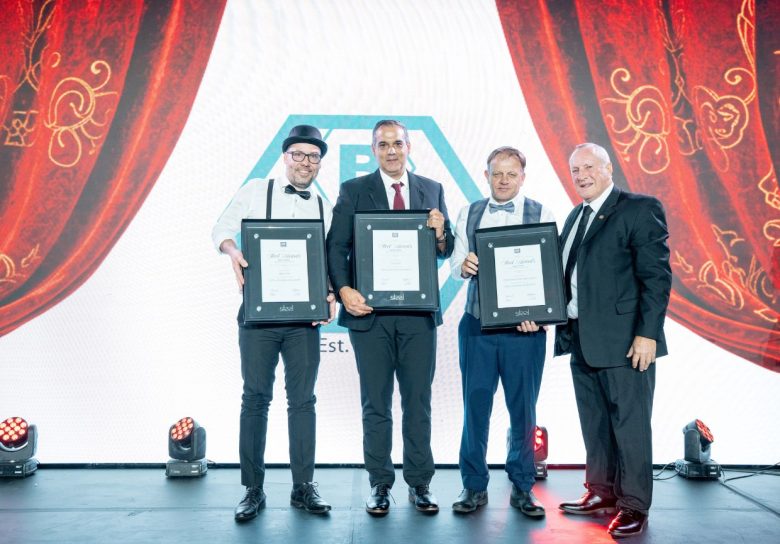
Bolt and Engineering Distributors (B.E.D.) has once again demonstrated its long-standing commitment to the South African and pan-African steel industry, through two prestigious sponsorships – the Pan-African Trailblazer and Architecturally-Exposed Steelwork – at the 2025 Southern African Institute of Steel Construction (SAISC) Steel Awards.

The annual event, which celebrates excellence in steel design, innovation and construction, recognises the contribution of companies that drive progress in the sector through quality, sustainability and innovation. For B.E.D., the Steel Awards sponsorships are a reflection of its heritage and a reaffirmation of its company ethos and values.

“For over four decades, B.E.D. has proudly supported the steel industry. We see steel as a symbol of the sector’s strength, ingenuity, perseverance and craftsmanship – values which align closely with our own,” says B.E.D. CEO Mike Giltrow.

“Through our fastening, welding, cutting, grinding, bearings, personal protective equipment (PPE) and export capabilities, we have become part of the industrial backbone which enables these incredible projects to take shape,” he points out, noting that many in the industry have conveyed their appreciation to B.E.D. for their support of the Steel Awards – and of the industry as a whole.

Recognising Pan-African innovation

The Export category award, presented by B.E.D.’s CEO Mike Giltrow as part of B.E.D.’s Pan-African Trailblazer sponsorship, celebrates individuals or teams who have made a significant contribution to advancing steel construction across the continent. This year’s winning project, the Botswana International University of Science and Technology (BIUST) student centre, showcased exceptional design and engineering, featuring 200 tonnes of steel and 5,200 m² of precision metal cladding.

“The BIUST student centre represents exactly what the Trailblazer sponsorship is about:  innovation, perseverance and excellence,” says Giltrow. “We are proud to support projects such as this: which push the boundaries of design, implementation and execution – proving that our pan-African steel supply chain skills and expertise can compete with the best in the world.”

Furthermore, B.E.D.’s pan-African Trailblazer sponsorship aligns closely with its expanding export division, which supports sub-Saharan African projects by providing the fastening, welding, cutting, and PPE equipment required for high-performance fabrication across the sub-continent.

“Our pan-African relationships are built on reliability, quality and collaboration,” Giltrow adds. “Despite challenges such as forex and market volatility, our export department continues to thrive – supporting our customers in Botswana, Namibia, Zimbabwe, and beyond.”

Architectural steel excellence

The Architectural category award, presented by B.E.D. MD Jan Viljoen as part of the company’s Architecturally-Exposed Steelwork sponsorship, honours projects in which steel is not just a structural necessity, but a defining design feature. The South African Civil Aviation Authority (SACAA) headquarters in Centurion was this year’s winning project, embodying the essence of this award category.

“This project’s intricate curved trusses and complex, three-dimensional roof geometry exemplifies the versatility and beauty of architecturally-exposed steel,” Giltrow explains, adding that the design required a combination of rolled steel sections, tubular supports and precision fabrication to achieve its seamless aesthetic – all while meeting rigorous green building standards.

“This project perfectly illustrates how steel can combine artistry and engineering,” remarks Giltrow. “It is a reminder that innovation is not only functional – it can also be inspirational. For B.E.D., recognising such craftsmanship reinforces our belief in supporting quality at every level: from the smallest fastener to the most intricate welding job – and more!”

Driving industry growth and skills development

As showcased at the Steel Awards, B.E.D. has grown into one of South Africa’s most respected industrial suppliers, with 15 branches nationwide and a strong network extending into the broader African continent. The company has long-standing relationships with world-class suppliers such as Fronius, SKF and CBC Fasteners – while also maintaining a proud commitment to supporting South African manufacturing:

“We are proudly local,” notes Giltrow. “Whether it is working with CBC on locally produced fasteners – or partnering with Fronius to introduce digital welding innovations, our goal is to strengthen the entire value chain of steel construction.”

In line with this vision, B.E.D. is developing a welding and cutting academy at its national distribution centre (DC), where young industrial artisans receive hands-on training in modern fabrication techniques. “It is not about earning points or compliance,” Giltrow comments. “We do it because it is the right thing to do:  to give back to the industry which has given us so much!”

A future forged in steel

As South Africa’s infrastructure sector faces a growing list of challenges, B.E.D. remains positively and energetically focused on solutions. Its support of the SAISC Steel Awards reflects a shared belief in the future of local and Pan-African steel sector.

“South Africa’s steel sector continues to punch well above its weight in terms of global industry quality and all-round excellence. We are proud to play our part in enabling that excellence: from fasteners and welding to training and export. Steelwork truly makes the dream work!” Giltrow concludes.

True grit: First Cut’s total grinding solutions ensure success for all applications, sectors and production volumes

First Cut, South Africa’s trusted supplier of cutting, welding and grinding solutions, has reaffirmed its position as a total solutions provider by offering a comprehensive range of grinding products across both its consumables and machinery divisions. Whether for light fabrication or heavy industry, First Cut’s grinding expertise spans applications, sectors, and production volumes: from large-scale producers to individual users.

“Our offering is about more than just selling grinding and cutting discs or equipment. It is about giving our customers the right product, the right advice and the right support to meet their needs,” says Stuart Beck, First Cut Regional Sales Manager – Coastal. “We serve the man in the garage, the large-scale production customer, the reseller and the wholesaler – and we treat each one as a priority.”

Deep understanding, full spectrum support

The grinding range at First Cut provides a full spectrum support, with machinery such as Timesavers for sheet metal finishing; as well as a growing range of professional-grade abrasive consumables. These include cutting discs, grinding discs and flap wheels designed for durability, safety and performance.

“At First Cut, we proactively focus on quality and consistency, avoiding generic power tools and instead positioning ourselves as a specialist in grinding solutions which contributes to our customers’ success,” Beck explains.

Customers benefit from the company’s deep understanding of production environments. Whether grinding stainless steel or preparing structural components, First Cut’s team guides customers toward the optimal grit, compound or abrasive formulation. This ensures not only product longevity but also reduces the risk of improper application.

Reducing waste and preventing corrosion

First Cut also plays a proactive role in helping its customers reduce waste, through expert application guidance which means users can avoid unnecessary rework or scrapped material. As Beck observes, using the wrong abrasive can compromise the end product: “We have seen customers grinding stainless steel with unsuitable discs which contain iron. The ensuing contamination may not be visible immediately, but over time it causes corrosion – which could ruin an entire batch of work. We help prevent that by recommending the correct abrasives from the outset.”

This guidance not only reduces material losses, but also cuts down on production delays and costs associated with rejects. “Our sales representatives are trained to spot these issues. Sometimes it is as simple as switching to a different grit size, or advising the customer to avoid cross-contaminating materials. Those small adjustments can save a great deal of money and reduce scrap,” he says.

Many of First Cut’s customers have established recycling processes for off-cuts and waste material. By helping to ensure that less needs to be reworked or discarded, First Cut supports customers’ sustainability efforts on the factory floor.

Best-in-class safety and practical training

All abrasive products supplied by First Cut meet strict international safety standards. The team ensures that customers receive clear guidance on proper installation, handling and use. “We do not just drop off the product. We show the team how to use it, how to mount it safely, and what not to do,” Beck advises. “We will never sell anything which lacks the required markings or safety certification.”

Training is supported through in-person visits, hands-on product trials and knowledge-sharing from international partners. The result is a sales team which not only understands the products, but is able to deliver practical advice and support in the field.

Customer-led innovation and measurable results

With increasing demand and positive feedback, First Cut continues to expand its grinding range. “We have grown consistently month-on-month since launching our professional abrasive line,” says Beck. “Now, customers are asking for more sizes – and that is a sign of success. If First Cut and the product did not perform, we would not be growing the range!”

Live cutting tests and head-to-head comparisons have helped the team win major accounts. “Once we prove that our product lasts longer and cuts better, the results speak for themselves. With grinding solutions that combine precision, sustainability and expert service, First Cut is showing ‘true grit’, and enabling South African manufacturers to cut smarter, grind better and waste less,” Beck concludes.

Colossal Concrete Products: two years down the track in De Aar – Firmly on track to leverage the rail revolution, and to diversify

In October 2023, South Africa’s leading concrete sleeper manufacturer, Colossal Concrete Products (CCP), re-opened its moth-balled railway sleeper manufacturing plant in De Aar in the Northern Cape, a courageous move which has left it perfectly positioned to benefit from the subsequent rail revival in South Africa and across the African continent.

The re-opening – initially to manufacture railway sleepers for a Transnet Freight Rail (TFR) contract – was also a strategic move in the wake of growing pressure for government to address the long-term underinvestment, vandalism and lack of maintenance which has all but crippled South Africa’s railway system.

The recent announcement that 11 new private sector players have been authorised – and are in negotiations with government to operate alongside the state-owned entity for six key routes – is a long-awaited breakthrough.

For Chief Executive Officer Gwen Mahuma-Madida, this will be a game-changer – not only for companies such as Colossal Concrete Products, but also for exporters and importers which will benefit from a more competitive, reliable and efficient logistics network. Moving freight from road to rail will not only cut costs and wear and tear on infrastructure, but potentially unlock bottlenecks at ports, boost mining and export revenues and even reduce carbon emissions.

Appointing private sector operators will also enable government to leverage private investment to repair and upgrade the railway system.

Two years down the track

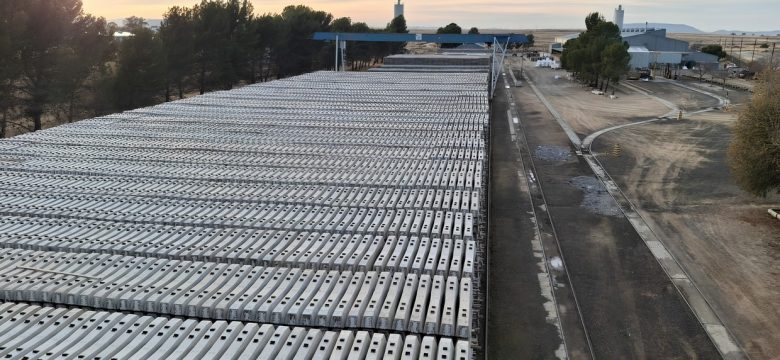
The De Aar and Brakpan facilities, which have supplied industry with pivotal precast infrastructure products for over 65 years, produced the first concrete rail sleepers in 1958 and have been recognised as trailblazers in rail infrastructure innovation ever since.

“We are extremely grateful that the facility has remained fully functional – and that we have been able to make a positive impact in the lives of our people there, and in the local economy. One of our greatest achievements has been the exceptional quality of the products produced at De Aar, with very low reject levels,” Kiewiet enthuses.

On track for diversification

Technical Sales and Service Manager Werner Booyens, who is part of the business development team, says that in addition to manufacturing railway sleepers and related rail infrastructure, Colossal’s De Aar facility also produces water channels and chutes, precast concrete culverts, IWJ (in-the-wall joint) pipes, valve chambers, sump/pump station rings and certain sizes of kerb stones for the renewable energy and agricultural sectors, and related regional projects.

The De Aar facility also produces concrete water and feeding troughs for sale directly to farmers or via agricultural co-operatives.  Furthermore, renewable energy plants – both solar and wind – are a key target market. Colossal Concrete De Aar produces three types of trench covers for renewable energy installations – a product which Booyens is confident will continue.

Other products – which are yet to be manufactured at De Aar – are the concrete poles / masts which would appeal to municipalities reaching as far as Kimberley. “Back in the day, the De Aar facility supplied the masts for the 150 kilometre Kimberley-De Aar electrification project. It also supplied the masts which facilitated the supply of additional power to the iron ore line,” says Operations Executive Chris Marinaki.

According to Kiewiet, the company is open to new ideas and new applications for existing products – and is prepared to work alongside potential customers. For example, over the past few months, Colossal has worked with consulting engineers to develop container plinth foundations within which electrical equipment is stored on wind farms.

The same goes for the railway engineers who are set to revitalise and potentially increase South Africa’s rail network. Colossal has capacity to deliver a million concrete railway sleepers per year from its De Aar and Brakpan facilities.

“Our vision for the De Aar facility – and indeed for Colossal Concrete Products as a whole – is to be a fully functional rail, infrastructure, pole and mast manufacturer: a one-stop concrete infrastructure products provider which can support the public and private sectors across South Africa,” Mahuma-Madida concludes.

AES makes a solid case for coal and biomass as fuel source options

Solid fuels such as coal and biomass (for example, wood chips) are both cost-effective and readily available fuel source options. However, both come with unique benefits and challenges says specialist steam and boiler operations maintenance and service provider, Associated Energy Services (AES).

Once fed into a furnace, solid fuel takes time to ignite. Conversely, liquid or gaseous fuel allows for almost immediate ignition: “The response of liquid- or gas-fueled boilers to any changes in steam demand is rapid. With solid fuels, there is a delay in the response of the boiler to ramp up adequately and meet the new demand,” explains AES Operations Director Ray Lund.

“With biomass – where moisture content can fluctuate between 20% and 55% – the response is even slower than coal, as it takes time to drive off extra moisture before ignition,” he adds.

When solid fuels are best

Given these ignition response considerations, Lund points out that solid fuels are ideally suited to processes with stable steam demand profiles, where there are few fluctuations.

However, a good operator can improve response time: “We run coal-fired boilers where the load changes quite significantly. Operators must be on their toes to accommodate that. Good boiler control systems should automatically adjust boiler settings to respond to a sudden steam increase or decrease – however operator intervention is required if the shift in load is large – especially since solid fuel quality is typically variable.

If the amount of steam required reduces significantly, the thermal heat being generated in the boiler must then be reduced very quickly. The control system will respond, slowing down or even turning off the fans as required, and the operator will also manually reduce fuel feed or remove fuel if needed.

The boiler will, however, remain safe when steam draws are rapidly reduced: “If too much heat is generated in relation to the amount of steam being removed, the safety valves lift to release the excess pressure to protect the boiler.”

Should water levels in boilers drop below ‘extra-low’ levels (an emergency event), operators should immediately remove the heat source to prevent boiler damage: “Hence the need to have operators on site. With gaseous and liquid fuel systems, automatic cut-outs ensure no further fuel is added. In a solid fuel system, the furnace fuel continues burning – and must be physically removed from the furnace by an operator,” he notes.

Managing sites with steam supplied to many different production lines adds complexity since each line has an independent steam draw profile.

Start-ups of such a plant need to be carefully managed, by ensuring that numerous production lines do not start simultaneously, preventing steam demand peaks as the heavy start-up steam draws of the various lines overlap. Such a large steam draw increase could be catastrophic in terms of maintaining steam pressure resulting in products not meeting specifications, including a potential loss of product sterility.

AES Commercial Director Dennis Williams cautions that solid fuels are not recommended when using thermal oil: “Localised cracking of thermal oil might occur due to overheating – resulting in carbon build-up on the inner heat transfer surface. This can create a hot spot that can ultimately rupture. Hot oil added into the combustion space of the boiler presents a major fire risk.”

Switching – and managing – solid fuels 

Changing solid fuels – from coal to biomass – as well as managing the use of each optimally also presents challenges.

Williams and Lund recommend firstly identifying the fuel of choice, secondly ensuring it is consistently available and thirdly, that the correct technology is implemented to optimise combustion: “Composition, sizing, combustion characteristics and moisture content are different for each solid fuel type – and should be considered in selecting the technology to be used to generate steam.”

Typically, coal-fired boilers in industrial applications require coal of between 6 – 25 mm in size, with a gross calorific value of 27,5 MJ/kg. Variations within coal seams at the mine – as well as process variations in the crushing, screening and washing of the coal – can result in sub-standard fuel quality from coal suppliers – and must be monitored by the user.

AES ensures that the coal supplied to the sites they operate meets specifications: “We sample every single load and test it in our internal laboratory in Cape Town. That way, we can hold our suppliers accountable,” says Lund.

An additional challenge is managing the fines content. This becomes increasingly difficult when coal is transported over long distances. “When coal is subjected to vibration during transport – or is tipped in or out of a transport vehicle, the sizing degrades. This has a significant impact on efficient energy extraction.”

There are also important safety protocols which staff need to follow when storing solid fuel: “There is a small risk of engulfment, where a large coal stockpile could collapse onto someone. There is also the admittedly rare risk of spontaneous combustion,” Lund extrapolates.

Williams and Lund note that biomass fuels can potentially be consistent in size and moisture content: “This is however contingent upon it being prepared specifically to be used as fuel. When purchasing material such as off-cuts and production residue, the outcome varies,” Lund concludes.